How did humans learn to count without making mistakes?
Last session four machines were destroyed by the way a number was written down. Nobody handed us that way of writing. It was invented.
Open by collecting the send-off. Two or three failures from the room, sixty seconds each, then straight into the shepherd.
the shape of this hour
Every counting system ever invented was a fix for one specific mistake.
Not one of them was designed by a mathematician sitting down to design a numeral system.
Each was somebody with a practical problem, losing something, and finding a way to stop losing it.
So for each one, the question is: what error did this eliminate?
And the follow-up, which is the more interesting one: what did it cost to eliminate it?
Set this frame explicitly. It's the thread through six systems and forty thousand years, and without it the hour is just history.
forty thousand years ago
You have a flock of sheep.
In the morning they go out to graze. In the evening they come back.
Did they all come back?
You cannot count them. Not because you are bad at it.
Because counting does not exist yet. There are no numbers. There is no word for how many you have. Nobody has invented one.
Push on this. Students assume the shepherd is uneducated. He isn't. The tool doesn't exist. Nobody anywhere has it.
the fix
One pebble per sheep.
In the morning, as each sheep walks out, drop one pebble into a bag.
In the evening, as each sheep walks back, take one pebble out.
If the bag is empty, they all came home.
the bag
Eight went out. Eight came back.
Run it. The point is the leftover pebble. The shepherd knows something is wrong without knowing the word "one".
what that eliminated
The error of remembering.
Memory is the thing that fails. The pebbles do not need memory. They are the memory.
And notice what it does not need. No numbers. No words for quantity. No arithmetic. Not even the idea that "how many" is a thing you could ask.
One thing standing for another thing. That is the entire invention.
The Latin for pebble is calculus. It is where we get the word calculate. The word is a fossil of a man with a bag of stones.
The etymology usually gets an audible reaction. Let it land, then say Mesopotamian accountants were still doing exactly this with clay tokens thousands of years later.
but
Four hundred sheep is four hundred pebbles.
The bag grows exactly as fast as the flock. It never gets easier.
You cannot say how many you have. You cannot write it down. You cannot send it to anyone.
And you certainly cannot ask what happens if you buy a second flock the same size.
The pebbles record a quantity perfectly and let you do nothing with it.
This shape repeats all hour: every fix solves one error and creates the next problem. Name it as a pattern the first time.
the oldest one we have found
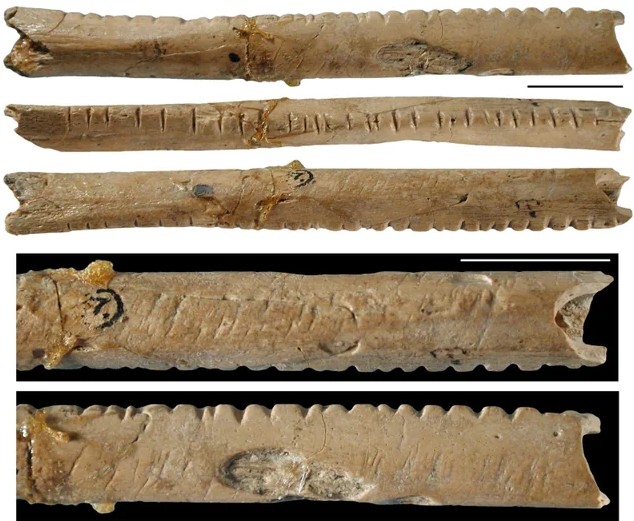
The Lebombo bone.
A baboon's fibula, about six centimetres long, cut with 29 deliberate notches.
Border Cave, in the Lebombo mountains on the border between South Africa and Eswatini. Radiocarbon dating puts it between 42,000 and 44,000 years old.
Twenty-nine is roughly a lunar month, so it may be a calendar. We do not know. What we do know is that somebody was keeping a record on purpose.
img/lebombo.jpg
DROP THE PHOTO IN AN img/ FOLDER NEXT TO THIS FILE
border cave · kwazulu-natal museum
Say the number out loud: forty-three thousand years. The oldest thing in this course by a factor of a thousand.
twenty thousand years later
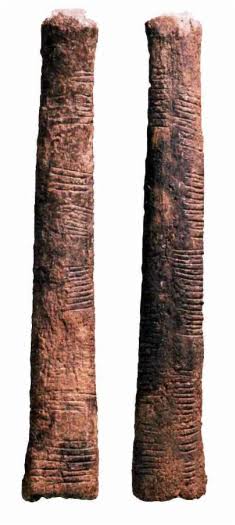
The Ishango bone.
Also a baboon's fibula, about ten centimetres, with a sharp piece of quartz still fixed into one end for cutting.
168 notches, but not in a line. In three columns, and inside each column the notches sit in groups.
Somebody stopped making a mark per thing and started arranging the marks.
img/ishango.jpg
DROP THE PHOTO IN AN img/ FOLDER NEXT TO THIS FILE
royal belgian institute of natural sciences, brussels
Ignore the prime-numbers claims. They are contested and not the point. The point is grouping.
why that matters
How many marks is this?
Same quantity, same marks. One of them you have to count. The other one you can just read.
Ask for the count before grouping. Take three guesses. They will disagree. Then group it and ask again. Instant, unanimous.
the second error, eliminated
Grouping kills the error of scale.
You cannot look at forty-seven scratches and know it is forty-seven. You can look at nine bundles and two.
So: give the bundle its own symbol. Then give the bundle-of-bundles its own symbol. Keep going.
That idea, taken as far as it will go, is Rome.
This is the hinge into Roman numerals. Make it feel like the obvious next move, because it was.
rome
A new symbol every time you run out.
One is I. Five gets its own mark, V. Ten, X. Fifty, L. A hundred, C. Five hundred, D. A thousand, M.
It is compact, it is readable, and it was used across an empire for centuries by people running the largest accounting operation in the world.
the same quantity
47 marks
|||||||||||||||||||||||||||||||||||||||||||||||
XLVII
five symbols instead of forty-seven
Give Rome real credit here. The room will want to sneer at it, and the next slide works much better if they don't.
now try to use it
Multiply these two. Do not convert them.
XLVII × XIX
2:00
DCCCXCIII
Make them actually try. Walk around. Nobody gets anywhere, and they need to feel that before you explain why.
why you got nowhere
It is not that it is hard.
You were not slow, and you were not out of practice.
In XLVII, the X means ten wherever it sits. Position carries no meaning. So there are no columns.
No columns means there is nothing to carry into.
And if there is nothing to carry into, there is no procedure to follow.
There is no method you failed to remember. There isn't one. Roman arithmetic was done on a counting board and then written down.
"There is no procedure" is the sentence of the hour. Everything after this is people inventing one.
babylon · four thousand years ago
Two symbols. That is all.
A thin wedge for one. A corner wedge for ten. Pressed into wet clay with the end of a reed.
Two marks, and with them they wrote every number they ever needed, including astronomical tables we can still check.
And they grouped, not in tens, but in sixties.
two wedges, side by side
two in the sixties column, forty-seven in the ones column
Ask what number that is before you say. Somebody will work out 2 times 60 plus 47. That is them doing positional arithmetic without being taught it.
before I tell you anything
Where have you seen sixty before?
You have used base sixty every day of your life. Where?
60 seconds · 60 minutes
six sixties around a point
A clock face is a Babylonian artefact. So is a protractor. Four thousand years old, still on your wrist.
Ask it as a real question and wait. Somebody gets the clock quickly. Almost nobody gets degrees until you prompt with "how many degrees in a circle, and why such an odd number".
but sixty is not the invention
This is the invention.
rome · put the mark anywhere
this X is worth ten
Move it. Nothing happens. A symbol carries its whole value with it, so the columns are decoration.
positional · put the mark anywhere
this 3 is worth three
Move it. The value changes by a factor of ten, and the symbol never changed at all.
The mark stopped carrying its own value. Where it sits now carries part of it.
Click both rows in front of them. This is the single most important idea in the hour, and it is worth two full minutes on its own.
why that changes everything
Columns are what you carry into.
Once a position has a fixed weight, a column can overflow into the one beside it, and that is a carry.
Once carries exist, addition has a rule. Then multiplication has a rule built from addition. Then long division has a rule built from that.
Every arithmetic procedure you know is standing on position.
Rome had no columns, so Rome had no carries, so Rome had no procedures. That is the whole reason you got nowhere ten minutes ago.
Point back at the XLVII slide physically. The failure they felt now has a one word cause.
and yet
Babylon had no zero.
Position works because every column has a weight. But if a column is empty, what do you write?
Nothing. You left a gap. And a gap in wet clay looks like a slightly wider gap.
So the same two marks could mean three different numbers.
the same clay, three readings
You had to know from context which one was meant. The marks did not tell you. The clay does not know what its wedges mean.
That last line is Class 1's board line, four thousand years early. Say it in exactly those words and watch who notices.
mesoamerica · base twenty
Three symbols. And one of them is zero.
A dot for one, a bar for five, and a shell for nothing. Stacked vertically, each level worth twenty times the one below.
Independently of anyone, the Maya wrote down a symbol for none, and put it in a column, where it does real work.
how they wrote 47
Zero as a placeholder and zero as a number you can calculate with are two different inventions. The Maya had the first. India gets to the second.
forty thousand years, one problem
The same quantity, five ways.
show
Type 60, then 20, then 0. Watch which systems get elegant and which get ugly. That's the base showing through.
and then ten
Why ten? Look down.
There is no mathematical reason for ten. We have ten fingers. That is the entire argument, and it is not a good one.
But in India the three pieces finally came together in one system: ten symbols, position, and a zero that is a number, not just a gap.
In 628, Brahmagupta wrote down the rules for arithmetic with zero.
What to do when you add it, subtract it, multiply by it. And what happens if you divide by it, a question he got wrong, and which is still special-cased in the hardware you will build in this course.
Flag the divide-by-zero line. It comes back in Class 26 and again in Class 49 as a hardware trap.
how it got here
It travelled with the merchants.
In Baghdad around 825, al-Khwārizmī wrote a book on calculating with these numerals. His name, in Latin, became the word algorithm. The title of another of his books gave us algebra.
Europe resisted for three hundred years. Florence banned the new numerals from account books in 1299. Merchants used them anyway, because the books closed faster.
The winner was not the most elegant system. It was the one that made commerce cheaper. That is the same reason binary wins in Class 3.
what we actually gained
Now there is a procedure.
Columns exist, so there is somewhere for a carry to go, so there is a method, and the method is the same every time, for any two numbers, forever.
You do not have to be clever. You have to follow the steps.
the thing rome could not do
XLVII × XIX47× 19423470893
Do it on the board by hand while you talk. Thirty seconds. After two minutes of failing at XLVII × XIX, it lands hard.
so where does that leave us
We have agreed on how to write it down.
Forty thousand years, six systems, and one survivor that everybody on earth now uses.
Representation: solved.
So is computing solved too?
We have a procedure that needs no cleverness. Surely that is the same as having the answer.
Let somebody say yes. Then the last slide.
no
A procedure still needs somebody to follow it.
And people get bored, and tired, and distracted, which is the one error nobody in this entire hour has managed to eliminate.
Writing it down and computing with it are two different beasts.
Stop here. Say as they pack up: it needs no thought, so does it need a human? That's Class 3.