Last session ended with a procedure that requires no cleverness at all. Every step is mechanical. So let us find out what happens when a person actually runs one.
No preamble. Get to the next slide inside sixty seconds and put them to work.
paper out. everybody.
Work this out by hand.
12986478 × 98642879
3:00
No phones. No calculators. You know the method. You have known it since you were nine.
Make them do it properly. Walk the room. You want the sighing, the crossing out, the person who restarts.
hands up
Who got 1,281,023,577,990,162?
Some of you got something else. Some are not sure. Some stopped.
Nobody here is bad at multiplication. You have all done this correctly hundreds of times.
So why did it go wrong?
Count exactly how many chances there were.
Be honest about whether you would have got it yourself. The room needs this not to be a trap.
count the steps
Eight rows, each one shifted.
64 single digit multiplications.
64 carries inside the rows.
112 additions to stack the rows up.
About 240 elementary operations, and one slip anywhere ruins all of it.
Point at the staircase. Every row sliding one place left is a place value decision, and a misaligned row is the commonest failure in the room.
be generous to yourself
How often do you get one digit sum wrong?
your accuracy on a single step
99.0%
90%100%
9%
chance of getting all 240 right
Right ninety nine times out of a hundred, and still a one in eleven chance of finishing that multiplication correctly.
Drag it to 99.9%, which nobody achieves, and it is still only 79%. That is the number that lands.
and that number is optimistic
Your accuracy is not a constant.
That was step one, after a night's sleep, on the first problem of the day.
Now do forty of these. Now do them for eight hours. Now do that every day for a year, for a wage, on somebody else's numbers, with no way of checking.
The procedure is fine. The procedure always works.
The problem is that a human has to run it.
Thesis of the hour. Everything after this is consequence. Say it plainly and pause.
and people did exactly this for a living
For three hundred years, "computer" was a job title.
It described a person. Usually a room full of them, each handed one column of one table, working through it by hand, all day.
Observatories, navies, insurance offices, artillery ranges, census bureaus, and later NASA.
The word we use for the machine on your desk is a job description taken from the people it replaced.
Name a few: the Harvard observatory computers, the Mathematical Tables Project, the women at Langley.
and the errors were not academic
Ships navigated from those tables.
Nautical almanacs, logarithm tables, tide tables, firing tables. Printed, bound, and trusted absolutely by people who could not check them.
And they were full of errors, made by tired humans running two hundred and forty step procedures, thousands of times over.
One wrong digit in a printed table puts a ship on rocks, years later, hundreds of miles away, and nobody ever traces it back.
Same failure signature as Class 1. Wrong value, no warning, consequence far from the cause.
cambridge, 1821
Charles Babbage, checking one set of astronomical tables against another, finding error after error, is said to have burst out:
"I wish to God these calculations had been executed by steam."
The whole idea of this course, stated two hundred years ago, out of pure irritation.
Say the line, then stop. It does not need decorating.
so
Give the procedure to something that does not get tired.
Three hundred years of people trying exactly that. Your job for the next ten minutes is to spot the one thing every single one of them assumed without noticing.
Plant this properly. They should be hunting an assumption, not receiving a history lesson.
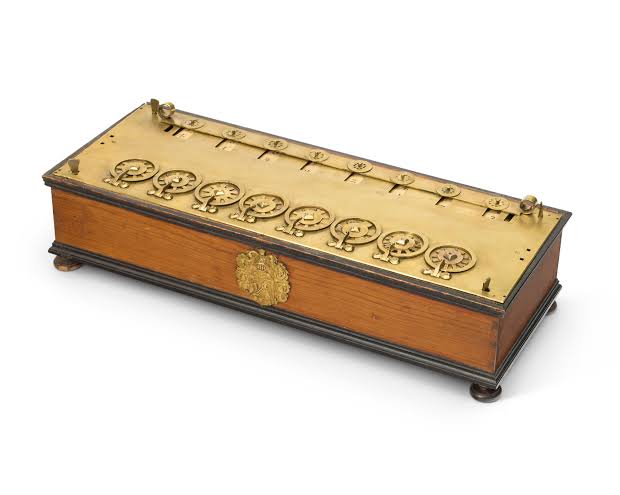
1642
The Pascaline.
Blaise Pascal, nineteen years old, builds a gear machine so his father can stop doing tax arithmetic by hand.
img/pascaline.jpg
OPTIONAL PHOTO
1642
Pascaline
1694
Stepped reckoner
1822
Difference engine
1890
Hollerith tabulator
1945
ENIAC
Nineteen years old, and this shape is every mechanical calculator for the next three hundred years.
watch the carry happen
Ten teeth. Then a nudge.
Each wheel has ten teeth, one per digit.
Turn the units wheel past nine and a linkage physically nudges the wheel beside it by one place.
That is a carry, made of metal. Step it from eight to nine to ten and watch the link fire.
two wheels of a pascaline
00
Step manually to the carry first so they see it as a discrete mechanical event, then hit run.
why that works so well
A gear tooth is a physical stop.
The wheel is not approximately at seven. It is at seven, because the metal cannot rest anywhere else.
Knock the table. Leave it a century. Run it in the cold. Still seven.
Ten states cost nothing when each state is a place a piece of metal can physically sit.
Remember that sentence. In about ten minutes it stops being true, and that is the whole hour.
Do not rush. The binary argument later is only this sentence being withdrawn.
1694
Leibniz makes the crank do the multiplying.
A brass cylinder with nine ridges running along it, each one longer than the last.
Slide the gear towards the short end and fewer ridges are long enough to reach it. Slide it back and more of them do.
One full turn of the drum strikes the gear once per ridge that reaches it. Set the gear so seven reach, turn the handle, and the counter goes up by seven.
slide the gear, then turn the drum
TOTAL0
Leibniz invented binary arithmetic in 1679 and published it in 1703. Then he built this, in base ten, and never connected the two.
Set the gear so three ridges reach, turn four times, and ask what they just computed. Three fours, by cranking. Then mention the binary.
1822
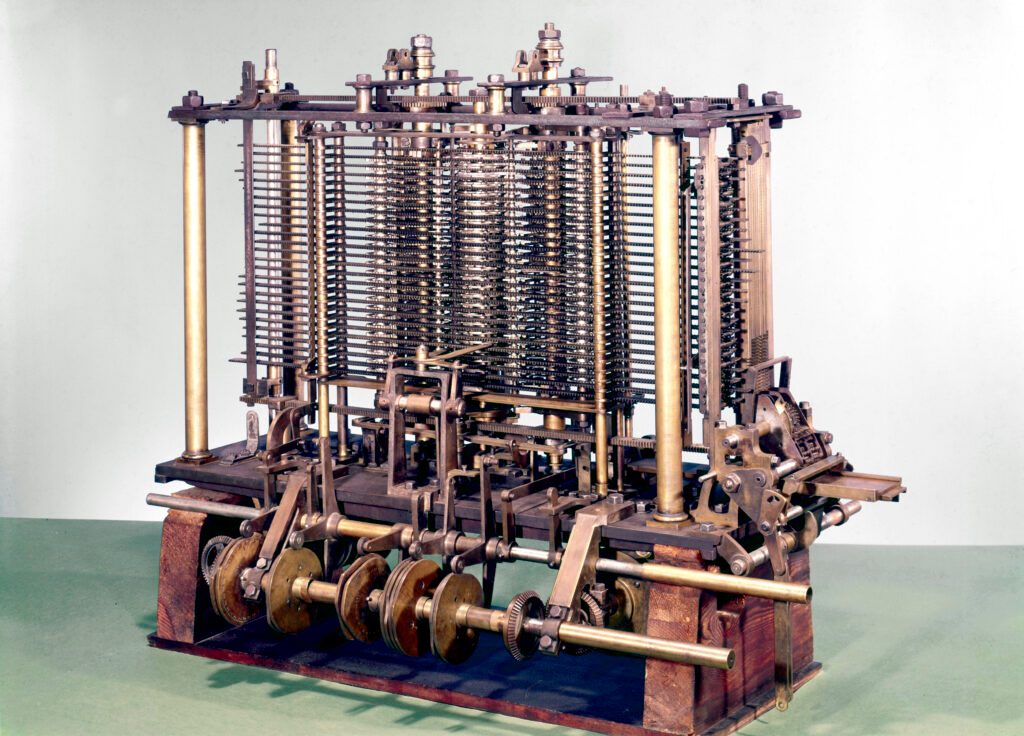
Babbage builds the steam he wished for.
The Difference Engine computes and prints mathematical tables, taking the human out of the typesetting too, because that is where errors crept in as well.
Thirty one decimal digits of precision. Gears, all the way down.
img/difference-engine.jpg
OPTIONAL PHOTO
1642
Pascaline
1694
Stepped reckoner
1822
Difference engine
1890
Hollerith tabulator
1945
ENIAC
Ask why a calculating machine needs a printer. The answer, that typesetters make mistakes too, tells you how seriously he took this.
first, look at the numbers
Write out the squares. Then look at the gaps.
The gaps grow. But the gaps between the gaps never change. They are two, forever, and you did not need to multiply anything to find that out.
Get them to compute the middle row out loud, then the bottom row. When the bottom row comes out all twos, that is the whole idea of the machine.
so run it backwards
Three registers. Two additions. Forever.
Every turn of the handle does two additions, in this order. Add the first difference into the value. Then add the second difference into the first.
The machine has no idea what a square is. It cannot multiply. It adds two numbers, twice per turn of the handle, and a table of squares falls out of it.
crank the handle
printed so far
Crank it slowly three times so they watch each arrow fire separately. Then run it and let the printed row fill up.
and now the part nobody tells you
The father of computing never built a computer.
The Difference Engine was begun in 1823 with government money, consumed over £17,000 of it, and was abandoned unfinished in 1842.
The Analytical Engine, the general purpose one with a store, a mill and punched cards, was never built at all. It exists as drawings.
In 1991 the Science Museum in London finally built Difference Engine No. 2 from his own drawings.
Eight thousand parts. Five tonnes. It works, and it is correct to all thirty one digits.
He was right. He was a hundred and fifty years early, and he never saw it run.
Worth saying out loud that being right and being buildable are different things, and the gap here was manufacturing tolerance rather than ideas.
1890
One card per person. Sixty million cards.
Every answer a household gives becomes a hole punched in one column of one card.
The card slides under a row of pins. Where there is a hole the pin drops through and closes a circuit, and the counter for that column steps by one. Where there is card, the pin stops.
Nobody reads anything. Nobody adds anything up. The population counts itself.
feed a card and watch the counters
Feed one card slowly first, so they see which pins stop dead on the card. Then feed twenty and point at the totals building with nobody counting.
1945
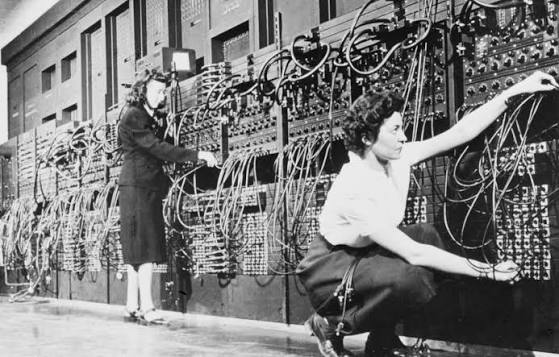
ENIAC. No gears at all.
Seventeen thousand vacuum tubes. Thirty tons. Nothing moves in the arithmetic. A thousand times faster than anything before it.
And it counted in decimal.
img/eniac.jpg
OPTIONAL PHOTO
1642
Pascaline
1694
Stepped reckoner
1822
Difference engine
1890
Hollerith tabulator
1945
ENIAC
Hold back how it counted. The next slide is the punchline of the whole history section.
look at what they built to get ten states
Ten devices. One lit.
Each decimal digit was a ring of ten flip flops, with exactly one of them on at a time.
Every one of those flip flops has two states. Ten two state devices, wired in a circle, imitating one ten position wheel that no longer physically exists.
one decimal digit of eniac
00
Compare that with the Pascaline eight slides ago. Same picture. Same carry. No metal.
Flick back to slide 12 if you can. The two animations are deliberately the same shape.
three hundred years, five machines
Nobody ever chose base ten.
Not one of them sat down and compared bases. Decimal was not selected. It was inherited, from a species that happens to have ten fingers.
It was so obviously how numbers work that questioning it did not occur to anybody, including the man who had already invented the alternative.
And for three of those centuries it cost nothing, because a gear tooth is a physical stop.
This answers the instruction from slide 10. Ask them for it before showing it.
then the gear went away
There is no tooth inside a wire.
An electronic machine does not hold a digit as a position. It holds it as a voltage.
Voltage is continuous. It has no notches. It can sit anywhere, and it drifts.
So a question that never needed asking for three hundred years suddenly has to be answered.
How many voltage levels can you reliably tell apart on one wire?
The hinge. Everything before was history. Everything after is physics.
so let us actually try it
Send a digit down a wire.
how many levels on the wire
10
how much noise it picks up
200 mV
gap you have 278 mV
noise you get 200 mV
0
digit sent
0
digit read
misread0 of 0
Start it at ten levels and let it run twenty seconds so the misread count climbs. Then drag the levels down one at a time without stopping it. Say nothing while you do.
where that number came from
Five volts, ten levels.
Ten levels means nine gaps between them.
Five volts divided by nine is about 556 mV from one level to the next.
The decision point sits halfway. So a signal may drift by 278 mV before it is read as the wrong digit.
That is the entire budget. Two hundred and seventy eight millivolts, for everything that could possibly go wrong.
Do this arithmetic on the board rather than reading the slide. Twenty seconds, and it makes the next slide brutal.
now list what spends it
Everything does.
Resistor tolerance, five percent
up to 250 mV
Supply rail variation
up to 250 mV
Temperature drift across the part
tens of mV
Crosstalk from the wire next to it
tens of mV
Thermal noise, ground bounce, ageing
more
You had
278 mV
The very first line already spends the whole budget.
And nothing has been built, connected, warmed up, or run for ten years yet.
Have the room call these out before you reveal them. They will get most, which makes the conclusion theirs rather than yours.
the only move left
Use two levels instead.
Nothing else changes. Same five volts, same wire, same components, same noise.
The gap goes from 278 mV to 2500 mV.
Nine times the immunity, free, from a decision that costs nothing except giving up the habit of counting in tens.
And two is the floor. One level carries no information at all, so there is nowhere further to go.
Go back one screen, set levels to 2 and noise to maximum, and let it run. Zero misreads. That is the argument, made live.
and here is the consequence
Two levels means two symbols.
A wire can now say exactly one of two things. So the machine's entire alphabet is 0 and 1.
Which means every number inside it has to be written in base two. Not by choice. By what a wire can hold.
This is the step that was missing before. Two levels is a physics result. Base two is what that result forces on the arithmetic.
be precise about what just happened
Binary did not win on mathematics.
Nothing in that argument was about numbers. No proof, no elegance, no property of base two that base seven lacks.
Arithmetic works identically in every base, and in three classes we will prove that properly.
Binary won on noise margins.
An engineering answer to a physics problem, and it would have been the wrong answer in 1642, when the stop was made of metal.
Do not let anyone leave thinking binary is mathematically special. Class 6 depends on this separation.
except
We just threw away four thousand years of work.
It took that long to arrive at ten symbols, position and a zero, so that a person could compute without being clever.
The machine now refuses to use any of it.
Binary is obviously right for the hardware.
Binary is obviously wrong for the human.
Both halves are true at once and neither is negotiable. Let it be uncomfortable.
so this is what we have signed up for
To multiply two numbers.
Build it left to right, one reveal at a time. The two red arrows should look ridiculous, because right now they are.
And nobody wants to read their bank balance in binary.
A representation that is perfect for the wire and useless to the person holding it, with a pile of conversion machinery in between that nobody asked for.
Stop here. Do not resolve it. Next session: the two representations were never required to be the same one, and that is the first abstraction in the course.